Lemon-shaped planet orbiting neutron star
Space is full of mysteries. Strange planets are constantly being discovered there. Now, scientists have discovered a planet whose shape has changed all conventional ideas. This planet, which is the size of Jupiter, is not round, but looks more like a lemon.
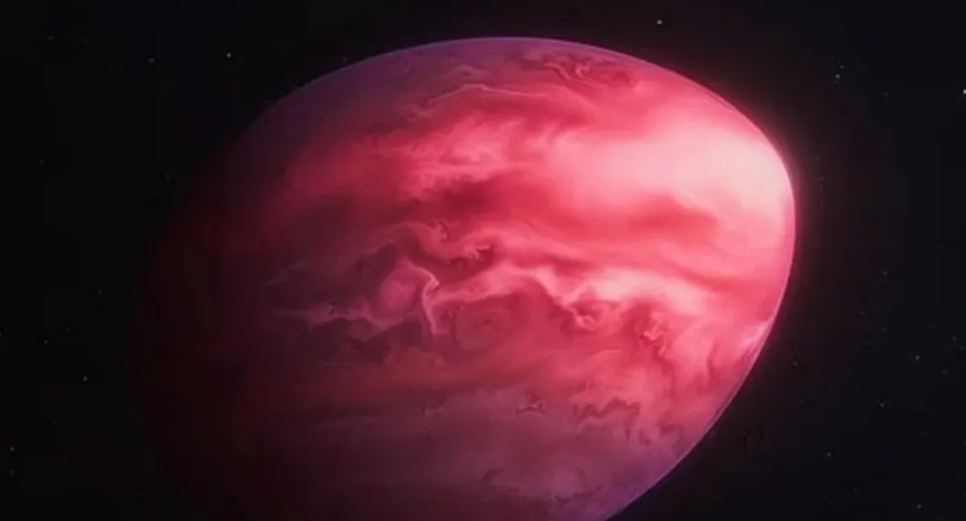
Michael Zhang, a researcher at the University of Chicago in the United States, said about this strange planet captured by NASA’s James Webb Space Telescope, that it has a type of atmosphere that has never been seen before.
Usually, carbon is combined with oxygen or nitrogen. But carbon has been found in this planet in its purest form, which seems almost impossible to scientists. How a planet can be formed from such elements is still a big puzzle.
This planet, named PSR J2322-2650b, is located about 750 light-years from Earth. The gaseous planet is not centered on any ordinary star, but rather orbits a pulsar or neutron star.
A neutron star is an extremely dense part of a dead star, where the mass of the entire sun is compressed into the volume of a small city. Various information about the planet has been published in The Astrophysical Journal Letters.
According to scientists, the planet is located only one million miles away from its star. Being so close, the neutron star’s strong gravitational force has pulled the planet into an elongated shape.
As a result, the planet has a perfect lemon shape. During the day, the temperature reaches 2,030 degrees Celsius, and at night it drops to about 650 degrees Celsius.
The planet’s atmosphere is different from any other exoplanet. Usually, water, methane or carbon dioxide molecules are found on alien planets. But here, rare molecules of carbon and helium have been found.
Scientists believe that there are clouds of ash or soot floating in its atmosphere. Under the intense pressure inside the planet, that carbon can condense and turn into diamonds.
The planet is orbiting its star very quickly. As a result, it completes a year there in just 7.8 hours. Peter Gao, a scientist at the Carnegie Earth and Planetary Laboratory in the United States, said that as the planet cooled, carbon and oxygen may have separated and formed crystals inside. However, the mystery of why oxygen and nitrogen are absent there is still unsolved.
Related Posts


About The Author
